


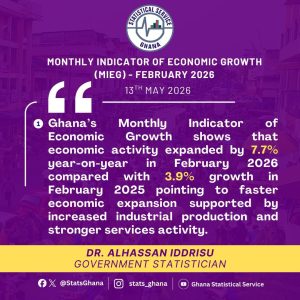
According to the latest Monthly Indicator of Economic Growth (MIEG), Ghana’s economic activity expanded by 7.7% in February 2026, compared with 3.9% in February 2025.
The Government Statsutician, Dr Alhassan Iddrisu said that this signals stronger economic activity across key sectors of the economy.
 The February 2026 MIEG provides an early picture of economic performance ahead of the official 2026 First Quarter Gross Domestic Product (GDP) estimates and highlights the important role of Industry, Services, and Agriculture in driving economic activity.
Addressing a press conference in Accra on Wednesday May 13, Dr Iddrisu said that “The MIEG for January 2026 has been revised to 6.1%, down from the provisional 7.5% estimate reported on 8th April 2026.
“This revision is mainly due to new data on fisheries, trade, manufacturing, electricity, public administration, education and health sub-sectors. Services sector saw the largest downward revision and industry was revised upwards.”
He added “The provisional MIEG estimate is 7.7% for February 2026, compared to 3.9% in February 2025. This shows that economic growth accelerated significantly in February 2026, indicating stronger market performance and increased confidence compared with 2025 levels.
“Economic Activities in Agriculture grew by 3.8%, compared to 9.4% in February 2025. This also indicates that the agriculture sector experienced a decline in performance compared to February 2025, reflecting a moderation in growth momentum.
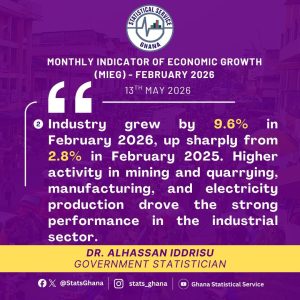
“The sector contributed 5.5 percentage to overall growth of 7.7%. 4. Industry recorded a growth rate of 9.6% in February 2026, compared to 2.8% in February 2025. This is an indication of an expansion in manufacturing, electricity and mining and quarrying activities, compared to the same period last year. ”
The sector contributed 44.2% to the 7.7% growth in the MIEG. Services economic activities expanded by 7.4% in February 2026, compared to 4.4% in February 2025.
The MIEG shows that the services sector expanded in February 2026, indicating an acceleration in growth compared to the same period in 2025. The sector contributed 47.6% to the 7.7% growth in the MIEG.”
 The Ghana Statistical Service said it remains committed to producing timely, accurate, relevant, and credible statistics to support evidence-based decision-making for national development.
“We sincerely appreciate all institutions, partners, respondents, and the hardworking staff of GSS whose dedication and collaboration made this release possible,” Dr Alhassan said.
