


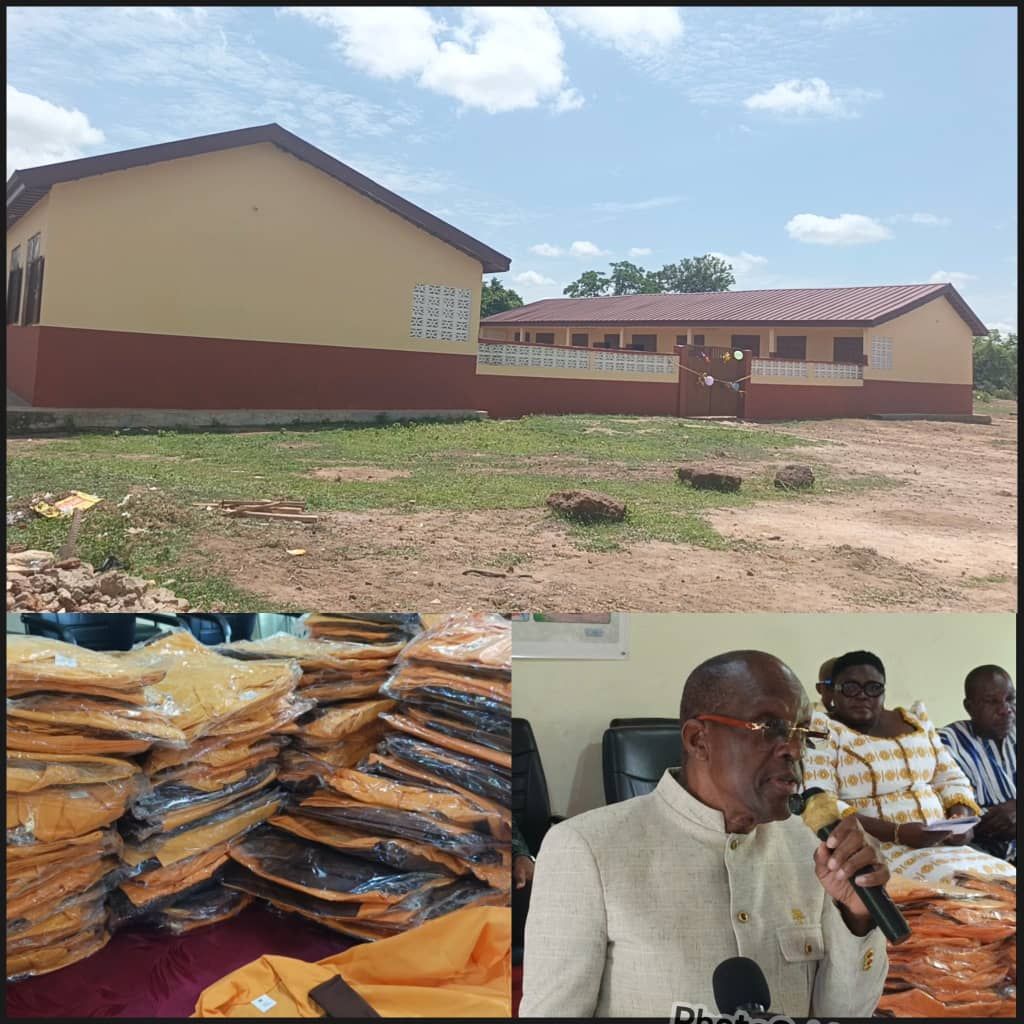
Speaker of Parliament, Alban Sumana Kingsford Bagbin, has facilitated the provision of 16,584 school uniforms for pupils in the Nadowli-Kaleo District of the Upper West Region, describing the intervention as a crucial step towards improving learning conditions and promoting discipline in schools.
Speaking at a short ceremony on Monday, June 8, 2026, to hand over the uniforms, and also commission two separate 6-unit classroom blocks with full ancillary facilities at Naro and Guree respectively, Bagbin said the support was made possible through his intervention with the Ghana Education Trust Fund (GETFund).
The uniforms will benefit 7,884 boys and 8,700 girls across 151 basic schools in the District.
According to the Speaker, school uniforms play a vital role in shaping the educational environment and contribute significantly to the academic and social development of learners.
He argued that uniforms help reduce socioeconomic differences among pupils by limiting visible displays of wealth through expensive clothing and accessories, which can often lead to bullying, exclusion, and unhealthy competition among learners.
“School uniforms reduce social distinctions among learners and create a sense of equality in the classroom. When all children are dressed alike, they are less likely to be judged based on their economic background,” he said.
Bagbin further noted that uniforms encourage discipline and responsible behaviour among students. He explained that adherence to a common dress code often fosters respect for teachers, peers, and the institution itself.
Drawing from his own experiences in the education system, the Speaker lamented what he described as a decline in professional appearance among some educators following the discontinuation of teacher uniforms.
“In the past, teachers served as role models through their neat appearance and conduct. Pupils naturally emulated them,” he said, stressing that both students and teachers benefit from maintaining high standards of dress and presentation.
The Speaker also cited research suggesting that uniforms help students focus more on their studies by reducing distractions associated with fashion trends and personal appearance.
“When students become overly concerned about how they look compared to their peers, it can create feelings of superiority or inferiority that distract them from learning,” he explained.
He said the standardisation of school attire creates a calmer and more focused learning environment, allowing students to concentrate on academic work rather than competition over clothing.
The Speaker expressed concern about the sight of schoolchildren attending classes in worn-out or ill-fitting uniforms, describing it as a reflection on parents and national leadership.
“The sight of unkempt children wearing torn uniforms to school is not only an eyesore but a dent on the reputation of parents and those of us entrusted with leadership,” he stated.
Meanwhile, Member of Parliament for Nadowli-Kaleo, Anthony Sumah Mwinkaara described the speaker’s intervention as timely and a burden taken off his head.
While touting the speakers’ interventions, he said this will add up to keep more children in class, improve attendance, and enhance learning outcomes.
On her part, the District Chief Executive, Mary Haruna, called for a stronger effort to address the fallen standards of education in the area.
“…we must confront the fallen standards of education in this district, especially our BECE results. Improving education will require the collective effort of government, parents, teachers, traditional authorities, and the community,” She stated.
